

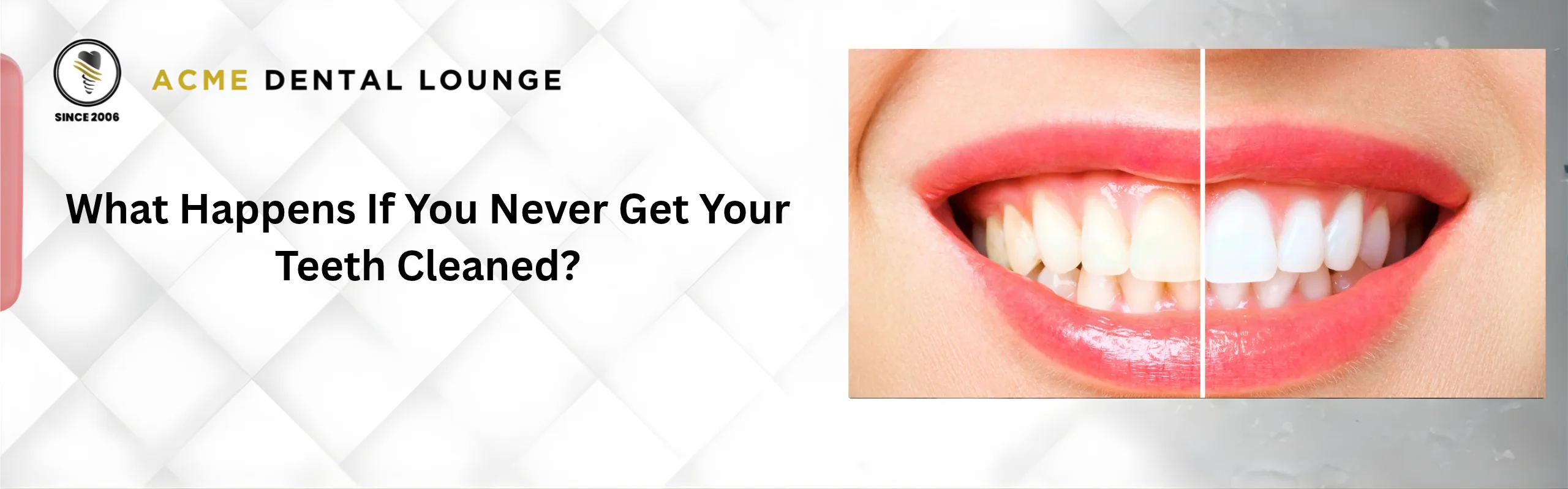
What Happens If You Never Get Your Teeth Cleaned?
Many people believe that you only need to visit a dentist if your teeth look unsightly, or your gums burn when you brush.Truthfully, this is a misconception.
Sometimes, dental problems have been festering for months or years before you begin to notice any symptoms.
You might not realize that unsightly plaque and tartar are building up along your teeth and gums.Without professional cleanings, there are some key consequences.
- Plaque Builds Up
Plaque is a biofilm that sticks to your teeth and contains bacteria.Every time you consume liquids or food, these microorganisms feast on the sugars, and the byproduct of this process can erode your teeth, leading to cavities.You can remove plaque from your teeth through brushing and interdental cleaning.
The issue emerges when you leave this biofilm on your teeth overnight or for prolonged periods during the day.
The Centers for Disease Control and Prevention (CDC) reports that hardened plaque or calculus, which appears on your teeth, cannot be removed by brushing alone.
You will need to visit a dentist for professional cleaning.
Here’s what occurs:
Plaque → Tartar Build-up → Gingivitis → Periodontitis → Loss of Teeth
- Gums Bleed Easily
A common sign that something is wrong with your gums is bleeding.It might be challenging to tell if your gums are inflamed or infected because bleeding happens during:
1.Brushing
- Flossing
- While Eating Chewing-Secured Foods
- After You Spit
Bleeding gums are usually not normal and are generally an early indicator of gingivitis, which is the first stage of periodontitis.
In most cases, gingivitis is effectively treated, especially if you are consistent with your dental hygiene.
Can bleeding gums repair themselves?
Depending on the seriousness of the condition, you might be able to reverse it.
However, you first need to obtain a professional opinion.
- Tartar Accumulates Along Your Teeth
One of the primary reasons that people visit a dentist is to remove tartar from their teeth.Your dentist can scrape off the hardened biofilm with specialized tools.
However, you cannot remove it at home.The longer you leave it on your teeth, the more likely it is to trap more plaque, which will lead to gingivitis.
- Foul-Mouthed Breath
Trust us, foul breath should be a nauseating experience for you and those around you.While bad breath typically stems from something that you ate, it could also be an oral condition, such as periodontitis.
Leftover food particles, bacteria, plaque, or calculus buildup around the mouth can cause halitosis.When you begin to notice that you need to gargle or use a mouthwash frequently, it is time to see a dentist.
The bad breath could be a symptom of an untreated infection that can only be resolved with antibiotics.
- Gingivitis Leads To Periodontitis
Gingivitis is the mildest form of periodontitis, and it can, unfortunately, progress to severe periodontitis if left untreated.
The CDC warns that periodontitis leads to the destruction of your teeth, causing them to loosen and eventually fall out.
The table below contrasts the two conditions.
1.Gingivitis –
- Early stage of periodontitis
- Inflammation of the gums
- Non-destructive and reversible
- Can be cured with professional treatment
- Does not lead to tooth loss
- Periodontitis
- Advanced periodontitis
- Destruction of the periodontal tissues
- Destructive and non-reversible
- Cannot be cured; it requires control measures
- Can lead to tooth loss
- Gum Recession
Periodontitis is a prominent reason why gums will begin to recede, or pull away from a tooth.As the gums shrink, more of the tooth root may be exposed.Consequently, you could experience:
- Increased sensitivity of the teeth
- More deposits on the roots of your teeth
- Greater susceptibility to periodontitis
- A change in your smile
Gums that retracted due to periodontitis cannot be replaced, although they can be surgically reattached.
- Development of Cavities
A professional cleaning is not a replacement for brushing and flossing.
Nevertheless, a trip to a dentist allows you to have your teeth and gums examined for signs of cavities, plaque, calculus, or infection.
According to the CDC, approximately 20% of Americans between the ages of 20 and 64 have at least one untreated cavity.Cavities usually do not cause any pain in their early stages.However, as the decay progresses and affects the nerves, it could lead to a toothache.
Other symptoms of cavities include:
- A throbbing or dull ache in the affected area
- Increased sensitivity to cold and hot liquids
- The tooth hurting when you bite down
- Food getting stuck in the cavity
- A dark spot on the tooth
- Tooth infection
If the decay reaches the tooth pulp and infects it, then you might need to get the tooth extracted, depending on the severity of the condition.
- Tooth Sensitivity
As you have probably guessed, one of the primary benefits of professional teeth cleaning is the prevention of tooth sensitivity.
However, if you have had untreated periodontitis, untreated cavities, or plaque buildup, you might develop sensitivity.Avoid drinking water that is too cold or eating anything that is too hot.
If you experience a sharp, excruciating pain as you consume certain foods and liquids, then you need to see a dentist.
- Mobility of Teeth
Healthy teeth are firmly planted in healthy gums, supported by the periodontal ligament and jawbone.Conversely, teeth that have periodontitis may become mobile, or wobbly.It is not possible to reverse the damage that has been done to the tissues and bones around the teeth.Nevertheless, you can control the condition.
- Tooth Loss
One of the most damaging effects of periodontitis is tooth loss.Periodontitis and cavities are the main reasons why people lose their teeth, according to the CDC.Losing a tooth can have more severe effects than you might imagine.
You may have to adjust how you chew your food.If you lose too many teeth, your entire bite can change, which affects the health of your jaw.Besides, tooth loss makes it difficult to eat foods that you love.
It can also interfere with your speech.Finally, you may feel self-conscious about replacing a missing tooth or multiple teeth.
A complete denture, implant, or bridge can replace a missing tooth.However, it is much better to prevent the loss of a tooth.
Is Professional Teeth Cleaning Necessary If I Brush Twice a Day?
You might believe that brushing your teeth twice a day eliminates all of the bacteria in your mouth.While this is partly true, it misses a crucial step in caring for your teeth plaque and calculus removal.According to the American Dental Association (ADA), regular tooth brushing removes plaque from the tooth surfaces.
Nevertheless, you need a professional dentist to remove the hardened calculus from your teeth.Interdental brushing eliminates plaque from the space between your teeth.
A trip to a dentist allows the dentist to control bleeding from your gums and remove deposits, plaque, and calculus from the gum line.
How often should a person get a dental cleaning?
There is not a specific time frame regarding how often you should get your teeth professionally cleaned.
Some people may need cleanings as often as every 6 months if they are diagnosed with periodontitis.Conversely, healthy teeth and gums may only require a cleaning once a year or even less frequently.
Your dentist will advise you regarding the frequency of your teeth cleanings.The recommendation will depend on your personal needs and risk factors.
What Will Happen If I Have Not Been to a Dentist for Years?
You should not worry about the consequences of skipping dental cleanings for years.
The most practical thing you can do is visit a dentist so that he or she can determine how many years it has been since your last cleaning and professional dental cleaning.
At the very least, your dentist might recommend that you begin coming in for cleanings every 6 months or even once a year.
The dentist or dental hygienist will also examine your teeth for cavities, plaque, calculus, and tartar buildup.Finally, he or she will probably take pictures of your gums and teeth to check for periodontitis.
Can Dental Cleaning Damage The Teeth?
A professional cleaning performed by an experienced dentist should not damage your teeth.Nevertheless, it is normal for sensitive teeth to feel uncomfortable, or even painful, following a dental cleaning.
This sensitivity may be a result of exposed roots that were concealed by calculus buildup.The condition is temporary and does not imply that your teeth are decaying.
What Is a Deep Dental Cleaning Called?
A deep cleaning is not necessary after every cleaning.It is a more aggressive procedure that refers to scaling and root planning.
Scaling and root planning are usually recommended for patients that have periodontitis.A dental professional will remove deposits, calculus, and plaque from your teeth.In addition, he or she will smooth out your tooth roots so that your gums can reattach themselves.
Who Determines Whether I Need a Deep Cleaning or Not?
You should not decide whether you need a deep cleaning or not.The dentist will evaluate your gums to determine whether you have periodontitis.
Depending on the findings,the doctor will decide whether you need a regular cleaning or a deep cleaning.
5 Signs It’s Time You Didn’t Ignore Your Dental Health
You should set up an appointment with a dentist if:
- Your gums bleed frequently after you floss or brush your teeth.
- You have halitosis or bad breath that persists despite regular brushing and flossing.
- You have inflamed or sore gums.
- Your teeth have become mobile or the spacing between them has increased.
- You have a toothache or your teeth feel sensitive.
What Happens During a Professional Teeth Cleaning?
A professional cleaning typically consists of the following steps:
1.Examination of the condition of your teeth and gums.
- Calculus, plaque, and tartar removal.
- Cleaning and polishing of the teeth.
- Giving advice on how to care for your teeth.
- Treating cavities and periodontitis, if detected.
Can The Effects Of Not Getting A Dental Cleaning Be Reversed?
The effects of not getting a dental cleaning can either be reversed or controlled, depending on the condition. Periodontitis, for instance, cannot be cured, but it can be managed with scaling and root planning.
On the other hand, calculus and plaque buildup can only be reversed if you have not allowed it to harden.Gingivitis is a reversible condition, but it could become permanent if it progresses to periodontitis.Meanwhile, tooth decay can be managed by filling the cavities.Finally, bone loss is an irreversible condition.
Dental Cleaning Is More Than Just Having A Sparkling Clean Smile.Dental cleaning is an essential part of your dental hygiene.
It does not merely prevent your teeth from looking dirty; it also ensures that your gums stay healthy.
Professional cleaning also allows your dentist to detect problems early so that he or she can address them.
The CDC points out that oral conditions, such as cavities and periodontitis, are extremely painful and can lead to other health problems.
The earlier you deal with such conditions, the better.
Frequently Asked Questions
- What happens if you never get your teeth professionally cleaned?
Hardened plaque or calculus will accumulate on your teeth, increasing your risk of developing periodontitis, bad breath, cavities, and periodontitis.
Advanced periodontitis can damage the jawbone, leading to tooth loss. - Can brushing your teeth be a sufficient alternative to professional teeth cleaning?
Brushing your teeth is an important aspect of dental hygiene.Nevertheless, you still need to visit a dentist to have your teeth professionally cleaned.It is normal for people to believe that brushing and flossing can remove all the deposits, plaque, and calculus from their teeth.
However, this is untrue, and you are likely to end up with periodontitis if you do not have your teeth cleaned by a professional. - Is it normal to have a healthy-looking set of teeth and never have a dental cleaning?
No, it is not normal to wait until your teeth look unsightly to have them cleaned.You can deal with cavities, periodontitis, and other oral conditions at an early stage if you have your teeth examined and cleaned on a regular basis. - How often should a person get a dental cleaning?
There is no official recommendation for how often a person should get a dental cleaning.Some people may need to have their teeth cleaned as often as every 6 months, especially if they have periodontitis or are at a higher risk of developing it. - How long can you safely go without a dental cleaning?
There is no safe amount of time that you can go without a professional cleaning
Your dentist will determine how often you require a cleaning depending on your individual needs and risk factors. - Can you remove tartar at home?
You can get rid of soft plaque on your teeth by brushing and cleaning between your teeth.However, you should not try to remove calculus by yourself because there is a high chance that you will end up hurting yourself in the process. - Does tartar cause cavities?
You cannot say that tartar causes cavities, but it can increase your risk of developing tooth decay.This is because calculus creates crevices where germs and food particles can get stuck. - What Is the Difference Between Gingivitis and Periodontitis?
Gingivitis and periodontitis are two different conditions, but they can both occur simultaneously.
Gingivitis refers to the inflammation of the gums, and it is the mildest form of periodontitis.
On the other hand, periodontitis is a severe condition that destroys the periodontal tissues.Gingivitis can progress to periodontitis if it is not treated. - Can Gum Infection Clear On Its Own?
In most cases, you cannot treat a gum infection on your own.
The infection could either be periodontitis or gingivitis.You must seek medical attention because both conditions require professional treatment. - If I Haven’t Visited My Dentist in 5 or 10 Years, What Should I Do?
Do not be embarrassed, even if you have not visited a dentist in five or ten years.
The dentist can still help you, regardless of how long it has been since your last cleaning.
Conclusion-
Don’t Wait for Your Teeth to Hurt
One of the biggest misconceptions about oral health is that you do not have a dental problem unless you are experiencing excruciating pain.The truth is that you might not be aware that cavities or periodontitis have developed.
By the time you realize that you need to see a dentist, the condition might be too late to reverse.The only way that you can maintain healthy gums and teeth is by brushing and flossing your teeth consistently and visiting a dentist for regular cleanings and examinations.
If you cannot remember the last time you had your teeth professionally cleaned, then it is time to schedule a dental appointment at Acme Dental Lounge or Call us to book an appointment at -9923459984
Your gratitude will begin the moment that you start taking care of your teeth.