

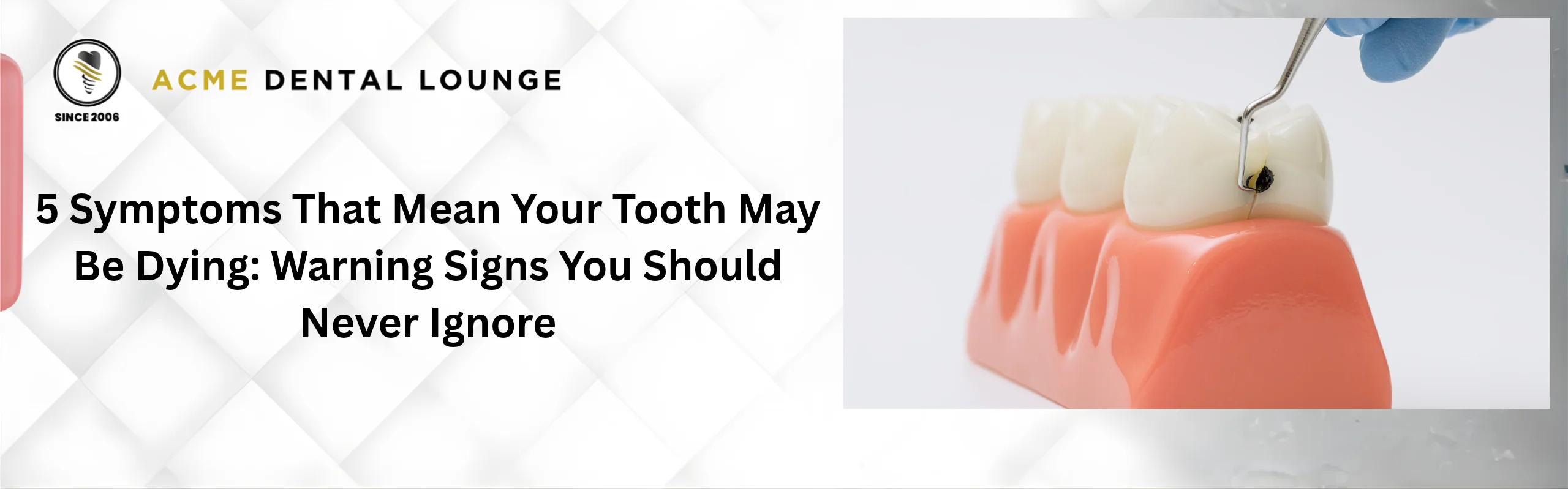
5 Symptoms That Mean Your Tooth May Be Dying: Warning Signs You Should Never Ignore
Is Your Tooth Trying to Tell You Something?
Has a tooth hurt unexpectedly for a day or two before calming down? Has one tooth changed colour compared to the others?
You may assume the trouble is over when the pain stops. But, there is a good chance that a tooth still has issues if it stopped hurting you.
Inside each tooth is a small bit of specialised spongy tissue called the dental pulp. This tissue contains nerves and blood vessels that keep the tooth alive. A cavity, injury, or fracture can damage the pulp in varying ways. In some situations, the pulp dies and can no longer keep the tooth alive. Pulp that is dead or dying is also called pulp necrosis.
The most challenging part about pulp necrosis is that a tooth experiencing it may not always cause you pain. Instead, you might notice that the tooth has changed colour or a pimple-like swelling has appeared on your gum.
The best part is that a dying or dead tooth can often be treated to prolong its lifespan with root canal treatment in Pune depending on the condition.
What Does It Mean When a Tooth Is Dying?
There are several reasons a tooth may die or begin to die, including:
- Deep cavities that reach the pulp
- A cracked or broken tooth
- Injury or trauma to the tooth
- Several dental procedures that injure the pulp or root
- Infections in the pulp or root canal system
- Dying or dead teeth do not always fall out on their own.
Even when the pulp dies and is no longer able to keep the tooth alive, bacteria can travel through the root canal and infect the surrounding tissue. A specialist dentist can perform tests to determine whether a tooth is dead or dying.
X-rays may also be taken to see if there is an infection in the root of the tooth.
5 Symptoms That May Mean Your Tooth Is Dying
- Lingering or Recurring Pain
One of the most common symptoms of a dying tooth is pain or discomfort.
Often, the pain is described as a dull ache, but it may also be throbbing or shooting and may come and go.
If you have pain in your tooth that you can’t seem to shake, it may be a sign of an underlying issue.
Additionally, the following are some of the other signs that tooth pain may be linked to pulp necrosis:
1.The pain is worse when eating certain foods
2.The pain “wakes you up” at night or is worse while lying down
3.The pain is worse on one side of your mouth
4.You continue to feel pain or pressure after eating something hot or cold
5.You feel pain or pressure in your jaw or ear
An illustration would be that you begin to experience pain in one of your teeth suddenly after drinking something hot. Even after the drink has been put down, the pain persists after a while. This is frequently an indication that the pulp of the tooth has been inflamed or infected.
Keep in mind that toothaches are typically not a normal occurrence.
While tooth pain can be a normal part of dental care, it can also be a sign that
something is wrong with your teeth, such as a cavity, infection, or a broken tooth.
Next, you should know what to do if you are experiencing a toothache.
What should you do?
Make an appointment to see a dentist as soon as possible if you’re having a toothache that won’t go away or that you’re not used to. They will most likely conduct a thorough examination of the painful tooth and possibly the surrounding teeth to determine the cause of the discomfort.
They may also recommend dental X-rays to rule out any issues with the root of the tooth. Based on what they discover, they may advise you to have a root canal procedure.
- Your Tooth Has Changed Colour
I trust you’ve paid close attention to the hue of your teeth.
If you haven’t, you may be surprised to learn that it’s not a vibrant, healthy shade.
Everyone has a different smile, but few people have perfectly white teeth.
If you’ve recently broken a tooth or suffered an injury, you may notice that your teeth have changed color or that one tooth is significantly darker than the others.
This can be an indication that your tooth is dying because of pulp necrosis.
What you should know is that if your tooth has been damaged or infected, it can begin to change color as a result of the damage or infection.
While the tooth’s color can change for a variety of causes, if the pulp dies, the tooth typically loses its natural color.
What should you do?
It’s crucial that you don’t make any assumptions about the cause of the discoloration. Make an appointment to have your teeth checked by a dentist so they can evaluate the condition of your teeth.
They may recommend a variety of treatments, including root canal therapy, based on what they discover.
- You Have a Boil or Pimple-Like Rash on Your Gum
You may notice a small, pimple-like sore or swelling on your gum.
This can be a sign that an infection has developed in your tooth’s root.
The sore or pimple might only be on one side of your mouth.
Other symptoms of a dental infection may include:
- A swollen area on your gum
- Tooth discomfort or pain
- A foul-smelling or -tasting sensation in your mouth
- Discomfort when chewing
- A swollen cheek
Although a numbness or tingling in your jaw or teeth can be a side effect of a dental infection, infections do not always result in a numb feeling in your mouth.
What should you do?
You should seek dental treatment as soon as possible if you notice a pimple-like sore or swelling on your gum.
A dental infection will not heal on its own and may require treatment, such as a root canal or extraction, to prevent spreading to other parts of your body.
Furthermore, the infection in your mouth has the potential to spread to other organs in your body.
What shouldn’t you do?
Don’t try to drain the pimple or boil on your gum.
What should you do next?
As mentioned above, visit your dentist as soon as possible to have the infection treated.
- Your Tooth Has Stopped Being Sensitive to Temperature
This may be a tough one to grasp.
We’ll use an example to describe it.
Say you drank a cup of hot tea and then began to feel a throbbing pain in your tooth. You get up from the table, move around a little, and the discomfort fades away.
You continue doing this for several months, and you’ve discovered that the pain only happens occasionally, specifically when you consume something extremely hot or cold.
Shouldn’t this indicate that your tooth has healed?
Not exactly.
Without a doubt, if your tooth has acclimatized to hot drinks, it has indeed improved.
However, as previously stated, when the pulp of a tooth dies, the nerve in the tooth loses its ability to sense hot and cold.
What should you do?
- If the sensitivity has decreased or disappeared, you should still have your teeth examined by a dentist to determine the underlying cause.
- Especially if the tooth has changed color or you’ve suffered an injury to your mouth recently.
- A dentist can perform a series of tests to see whether the pulp is still operating correctly.
- They may also take a dental X-ray to rule out any problems with the tooth’s root.
- You Have a Foul Taste or Odour Coming from Your Mouth
We understand that bad breath is an uncomfortable topic.
As a result, you’re more likely to dismiss it and hope it goes away on its own.
If your mouth has a foul taste or odour that persists for an extended period, it’s a sign that something is wrong.
The first symptoms of many oral infections are a foul-smelling or tasting discharge from the mouth.
You may also have a fever, a swollen and/or painful gum, and/or a throbbing pain in your tooth.
What should you do?
You should call your dentist if you’re having any of these symptoms.
When germs attack your teeth, they have the potential to spread to other parts of your body.
Hence, if you notice any of these symptoms, make an appointment to see a dentist as soon as possible to have the infection treated.
Some important thoughts that comes in mind
- Can a Dying Tooth Stop Hurting?
When the pulp of a tooth dies, the tooth may cease to be sensitive to hot and cold.
It’s also possible that the ache simply vanishes, leaving you with a tooth that appears to be in perfect health.
However, there’s a quite strong likelihood that an infection has developed at the root of the dying tooth.
The infection can linger and cause problems later if not treated.
What should you do?
Make an appointment to have your teeth checked by a dentist as soon as possible if you’re having any of these symptoms.
The dentist can perform a series of tests to rule out any issues with your teeth’s roots.
- Can a dying tooth be saved?
There are several options for restoring a tooth that has been infected or damaged.
The treatment will be determined by a variety of variables, including the amount of healthy tissue remaining in the tooth, the condition of the tooth’s root, and the dentist’s recommendations.
Dental condition Possible treatment
Pulp inflammation that may still be reversible Treatment of the cause and appropriate restoration
Irreversible pulp injury in a restorable tooth Root canal treatment
Infection in the root canal Root canal treatment (and, when indicated, drainage)
Tooth that is too damaged to be restored reliably Extraction may be recommended
Root canal therapy is the process of removing inflamed or infected pulp from the root canal of a tooth. The root canal is then cleaned and shaped, and the empty space is filled and sealed.
A root canal, on the other hand, does not always ensure that a tooth lasts forever. After a root canal, a crown is typically required to keep the tooth from breaking.
- When should I see a dentist?
As soon as you can, make an appointment to have your teeth checked if you’re experiencing any of the symptoms listed above.
When you see a dentist, they’ll most likely want to take a look at your teeth and x-rays to rule out any issues with your oral health.
The next step may be to have a procedure done on the affected tooth if an underlying condition is detected.
If you have a mild infection in your mouth, you should make an appointment to see a dentist as soon as possible so that it can be treated.
If you have a severe infection in your mouth, on the other hand, you should seek emergency care right away.
- What should I do in the meantime before my appointment?
While you wait for your appointment, you should take measures to ensure that the infected region is not irritated.
You should avoid chewing anything that might irritate the infected region, for example.
Brushing and flossing your teeth are also excellent ways to care for your teeth.
Over-the-counter pain medications should not be used to treat a painful or infected tooth. They should also not be used to numb a specific area of the mouth.
Topical analgesics such as aspirin should not be used on the gums or a sensitive tooth because they have the potential to burn the surrounding tissue.
Finally, and most importantly, don’t take any antibiotics that weren’t prescribed by a physician.
What shouldn’t you do?
Before your appointment, don’t try to remove any food that has lodged between your teeth.
Don’t take anything that wasn’t prescribed by a physician. Antibiotics, for example.
Frequently Asked Questions About a Dying Tooth
- What is the first symptom of a dying tooth?
There are a few early indicators that your tooth may be dying, but they are not always readily apparent. To help ascertain whether your tooth is in distress, a dental examination is recommended.
- Can a dying tooth repair itself?
When the pulp of a tooth dies, it can no longer generate new tissue, and the tooth cannot be repaired on its own. A dentist can, however, help to save the tooth. On the other hand, there are several kinds of pulp inflammation that can be treated.
- How do I know if my tooth nerve is dead?
There are various methods for determining whether the nerve in your tooth has died. Changes in the colour of your teeth, as well as a history of severe discomfort, are two of the most typical indicators. There are various other symptoms that may suggest that your tooth nerve is dead, but a dentist can perform a thorough examination.
- Can a dead tooth cause an infection?
When the nerve of a tooth dies, bacteria have free rein in the tooth, leading to an infection that can spread to the roots of the tooth and surrounding tissues. If an infection is suspected, a dentist can prescribe antibiotics to help fight it.
- Does a dead tooth always require a root canal?
It is not always necessary to perform a root canal on a dead tooth. If the dentist finds that a root canal is not an option, he or she may recommend extracting the tooth.
- Can a dead tooth be painless?
Dead teeth have the potential to be both excruciatingly painful and totally numb. If a dead tooth is not treated, it will most likely eventually become painful. As a result, if you have a dead tooth, you should have it evaluated and treated by a dentist so that it does not cause you discomfort.
- Is a root canal procedure painful?
A root canal procedure is performed while the patient is numbed. After the procedure is complete, the patient may experience some discomfort due to the numbing medicine wearing off.
- How soon should a dying tooth be treated?
It’s a good idea to schedule a dental appointment right away if you’re experiencing any of the symptoms of a dying tooth discussed in this article. If you have a root canal infection, you should seek emergency care because it requires immediate treatment.
Conclusion:
Don’t Ignore the Warning Signs Your Tooth Is Giving You
Does your tooth hurt, change color, or swell? Is your tooth becoming less sensitive to hot and cold drinks?
We sincerely hope that reading this post has increased your awareness of the symptoms of a dying tooth and the importance of seeking treatment. We’re confident that you understand why it’s a good idea to see a dentist if you’re having any of the symptoms mentioned above. We also hope you will reach out to us so we may help you. In many instances, it is possible to save a tooth that has been damaged, and doing so as soon as possible will give you the best chance of success.
If your tooth is causing you discomfort, Acme Dental Lounge is here to assist you. We are in Aundh Pune and specialise in the treatment of teeth that have been damaged.
We can help you save your natural teeth with our dental expertise.
Book your free appointment now!
Clinic: Acme Dental Lounge, Aundh, Pune
Booking contact: 9923459984
Your natural teeth are worth protecting. Take the first step toward a healthier smile today.