

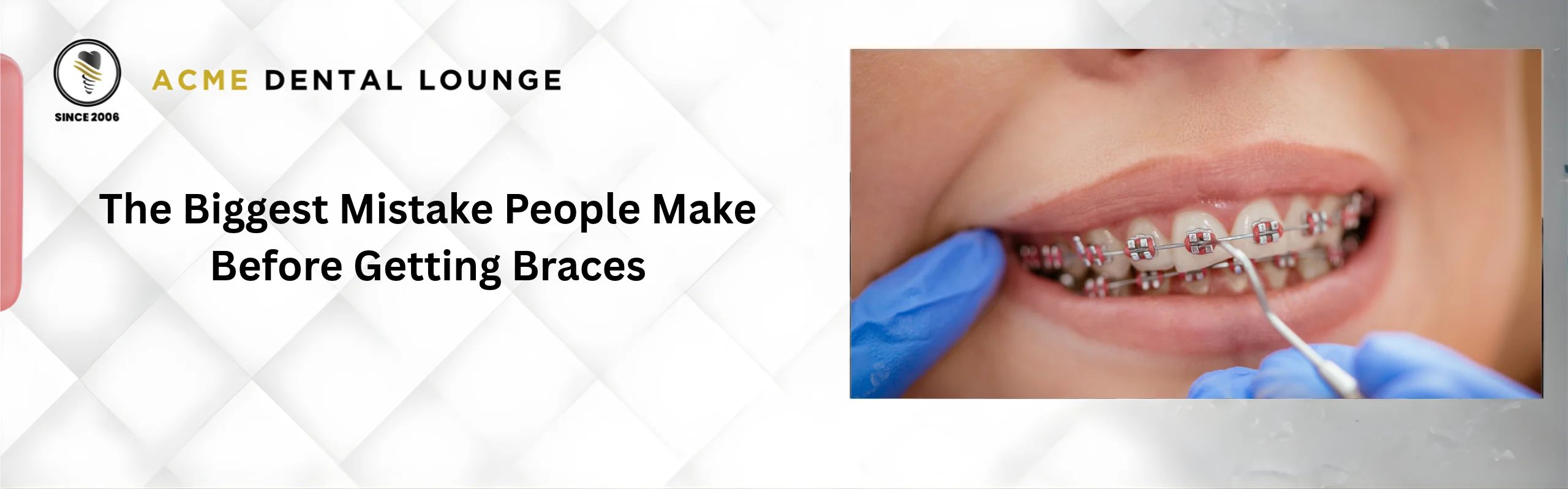
The Biggest Mistake People Make Before Getting Braces
The biggest mistake people make before getting braces is getting orthodontic treatment without addressing dental and orthodontic concerns that negatively affect oral health. While braces effectively straighten teeth, they do little to prevent cavities, gingivitis or other periodontal (gum) issues.
Before getting braces, it is necessary to perform a comprehensive orthodontic assessment, address any dental concerns, receive detailed information regarding the treatment options, and understand what orthodontic care one is about to invest time and money into.
The right orthodontic preparation can ensure better results and help prevent complications to teeth and gums throughout orthodontic treatment.
At Acme Dental Lounge, Aundh, Pune, we strongly believe that orthodontic treatment should be performed as a comprehensive treatment, as a way to obtain healthy, functioning teeth that a person can be truly happy about.
For appointments: 9923459984
So, What’s the Biggest Mistake Before Getting Braces?
Just imagine that you decided to get your teeth straightened.
Maybe you were finally done photographing your smiling with your mouth partially closed just to hide those prominent front teeth that stick out.
Perhaps your child had an overbite or spaced teeth that parents are finally ready to fix.
Some people had thought about braces for years, but something always came up.
Eventually, the right orthodontics clinic was found, the preferred type of braces was chosen and one thought the preparation was done. The next and final step, the person assumed, was to simply get the braces put in.
The truth is that there is one very important step that many people tend to skip before getting orthodontic treatment.
Preparing your teeth and gums for orthodontic treatment.The reason why this step is so important is that orthodontic appliances and brackets can provide additional areas for plaque to accumulate and untreated cavities, gingivitis (inflammation of the gum tissue) or poor oral hygiene can make it extremely difficult to properly care for teeth during orthodontic treatment.
According to the American Association of Orthodontists, prior to orthodontic treatment, patients should schedule and complete a dental cleaning and dental checkup, and continue taking proper dental care measures throughout the entire course of orthodontic treatment. Therefore, before asking “which braces are better,” it is important to first determine if one’s teeth and gums are ready for orthodontic treatment.
Why You Shouldn’t Rush Into Orthodontic Treatment
Orthodontic treatment involves using controlled forces to gradually move teeth into better positions within the mouth.
The process of orthodontic treatment itself is far from a simple one.
It is an intricate procedure which requires the cooperation and involvement of the patient throughout the entire treatment process.
According to the American Dental Association, orthodontic treatment helps straighten or align teeth and jaw bones.
The misalignment of teeth and jaws can lead to improper bite, improper lip closure, problems with chewing, excessive wear of teeth, and periodontal (gum) diseases.
Therefore, prior to orthodontics treatment, a dentist or an orthodontist will first have to evaluate and document one’s occlusion (bite), profile, lip and cheek fullness and jaw movements.
They will also make sure whether the available space within the mouth is sufficient to accommodate the teeth size, or if any teeth need to be extracted to make space for the remaining ones.
The orthodontist will also examine the periodontal (gum) tissues, check for the presence of any cavities, bite and oral hygiene, and the specific goals of treatment.
Once all of these factors are reviewed, an orthodontist will be able to recommend the appropriate orthodontic treatment option.
Mistake #1: Ignoring Cavities Before Getting Braces
This is one of the single most important factors that one must consider prior to orthodontic treatment. One cannot simply place bands and brackets on teeth with existing untreated cavities. Doing so would only further endanger the health of one’s teeth. The dentist will first have to determine which type of treatment will be necessary to restore the function and health of one’s teeth. Depending on the severity of the cavities, root canals, fillings, crowns or other types of treatment may be necessary before braces can be placed.
It is of atmost importance to inform one’s dentist about any cavities or other oral irregularities prior to orthodontic treatment.
Mistake #2: Starting Orthodontic Treatment With Unhealthy Gums
The health of one’s gums is just as important as the health of the teeth. If one has any inflamed or bleeding gums, bad breath, periodontal pocketing, recession, plaque, calculus (tartar), periodontitis or other periodontal issues, it is critical to schedule a periodontal evaluation before orthodontic treatment. The brackets and wires of orthodontic appliances can create additional plaque-retentive areas in the mouth, increasing the likelihood of developing gingivitis, cavities and white-spot lesions. ADA recommends brushing twice a day, flossing daily and regularly visiting the dentist.
Mistake #3: Assuming That Braces Automatically Fix All Dental Issues
One of the most common misconceptions regarding braces is that they effectively treat all dental and orthodontic irregularities. However, that is simply not the case. Braces are only effective at straightening teeth. They cannot, for instance, remove cavities, treat periodontal issues, replace missing teeth or repair cracked teeth. Orthodontic treatment is only a part of one’s overall treatment plan, and in some situations, it may even be necessary to consult with multiple dental professionals.
Mistake #4: Skipping Thorough Orthodontic Evaluation to Save Money
Let’s talk about money. That is a delicate subject, and one that many people are often not comfortable discussing. That is why many people skip a proper orthodontic evaluation in order to save money. Before making an appointment with an orthodontist, it is important to consider factors beyond the cost of orthodontic treatment. Instead of asking
“How much do braces cost?”
, one should also ask:
- Who will be involved in the treatment planning and administration of orthodontic treatment?
- What specific orthodontic problem do I have?
- What orthodontic treatment options do I have?
- How long will treatment last?
- What are the risks of treatment, and what happens if treatment fails?
- Do I need orthodontic imaging (X-rays, scans) for orthodontic treatment?
- Do I need to have my regular dental checkups throughout orthodontic treatment?
- What will the aftercare for orthodontic treatment be like?
- Do I have to wear a retainer after orthodontic treatment is complete?
- What does my treatment plan actually include, and what is the cost of this treatment plan?
Mistake #5: Choosing Orthodontic Appliances Prior to Orthodontic Evaluation
As mentioned previously, there are various treatment options which one can consider prior to orthodontic treatment.
Depending on the severity of the misalignment, one may be able to choose between traditional orthodontic appliances, such as metal braces, ceramic braces or clear aligners.
However, determining which treatment option is best depends on one’s bite, or the way in which the upper and lower teeth meet.
Malocclusion, or a bad bite, is a broad term which encompasses various irregularities of the teeth, including overbite, underbite, crossbite, open bite, spacing, crowding, rotated teeth and displacement of the teeth.
When it comes to orthodontic treatment, not only does the dentist have to consider the alignment of the teeth, but they also have to consider the occlusion, or the way in which the teeth fit together.
Mistake #6: Not Asking What Happens After Orthodontic Treatment
When considering orthodontic treatment, it is easy to forget about the aftercare of orthodontic treatment.
One of the most crucially important parts of orthodontic treatment is the retention phase, during which one has to wear a retainer to maintain the new position of the teeth.
It is impossible to overestimate the significance of this phase in orthodontic treatment.
One can spend months, or even years, getting their teeth straightened, only for them to shift back to their original position after the braces are removed.
Therefore, prior to orthodontic treatment, it is of utmost importance to understand the type of retainer, frequency of retainer wear and duration of the retention phase.
Mistake #7: Not Paying Enough Attention to Oral Hygiene During Orthodontic Treatment
Perhaps one of the most annoying aspects of orthodontic treatment is the additional focus on oral hygiene.
Prior to orthodontic treatment, brushing one’s teeth was a simple procedure which could be completed in a matter of minutes.
Suddenly, one now has to spend at least 2 minutes brushing their teeth, and 3 additional minutes flossing.
This is because orthodontic appliances and braces create additional areas within the mouth where food particles and bacteria can accumulate.
Hard calculus can also form around the brackets of the orthodontic appliances, putting one’s teeth and gums at risk.
According to the ADA, orthodontic treatment increases the likelihood of developing cavities, and the use of high-sugar food products and inadequate oral hygiene during orthodontic treatment can lead to white-spot lesions around the brackets of orthodontic appliances.
What You Should Do Prior To Orthodontic Treatment
It is best to think of the entire orthodontic preparation as a simple checklist.
Step 1: Dental Check Up
It is critical to ensure that one’s teeth and gums are in a healthy condition prior to orthodontic treatment.
The dentist will be able to detect any cavities, periodontal issues or abnormalities which require special attention prior to orthodontic treatment.
Step 2: Professional Teeth Cleaning
If one has excessive buildup of plaque or calculus (tartar), professional cleaning prior to orthodontic treatment will be necessary.
Step 3: Treating Cavities
If one has any cavities which require treatment, it is critical to arrange a dental appointment to have them treated.
Step 4: Treating Periodontal Issues
If one has inflamed or bleeding gums, it is critical to schedule a periodontal evaluation prior to orthodontic treatment.
Step 5: Orthodontic Evaluation
The next step is to have an orthodontic evaluation, during which the orthodontist will closely examine one’s teeth, bite and jaw.
Depending on the case, the orthodontist may also request a series of photographs, scans, impressions and X-rays.
Step 6: Discuss Treatment Options
During this step, one can discuss the treatment options with the orthodontist.
Depending on the current dental condition, one may be able to choose between a variety of treatment options, such as traditional metal braces, ceramic braces or clear aligners.
Mistake #8: Thinking That Orthodontic Treatment Takes the Same Amount of Time for Everyone
While it is obvious that everyone has a different bite and a different degree of misalignment, many people still assume that orthodontic treatment takes the same amount of time for everyone.
The truth is that the entire treatment timeline can vary significantly, depending on one’s age, degree of crowding, type of malocclusion, required tooth movement, skeletal maturity, type of orthodontic treatment and patient compliance.
In other words, each patient has a unique combination of factors which determine their treatment timeline.
According to ADA, the majority of orthodontic treatment plans last between 1 and 3 years, on average.
However, one should be wary of any orthodontist who can provide an exact estimate of one’s treatment timeline.
Everyone’s teeth are different! No two people have the exact same teeth.
Does Age Differentially Affect Orthodontic Treatment Outcomes?
Orthodontic treatment is usually recommended for adolescents, as they have a higher chance of obtaining long-lasting results.
However, the health of the teeth and gums is far more important than the age of the patient when it comes to orthodontic treatment.
For younger children, the American Association of Orthodontics recommends scheduling the first orthodontic screening by age 7, to determine whether early orthodontic treatment is necessary.
It is important to remember that orthodontic screening is not the same thing as orthodontic treatment.
Sometimes, the most effective treatment option is to simply monitor the progress of one’s dental development and wait for the appropriate time to begin orthodontic treatment.
If You Have Been Recommended Orthodontic Treatment…
Do not forget to ask questions!
A competent orthodontist will be able to clearly explain the orthodontic diagnosis, the specific orthodontic treatment options and the risks and benefits of orthodontic treatment.
It is also important to remember that orthodontic treatment comes in a variety of methods, materials, costs and complication rates.
When asking the orthodontist, one should ask:
- Are braces necessary in my case, or are there other treatment options?
- Do I need to extract any of my teeth for orthodontic treatment?
- How long is the estimated treatment duration?
- It is best to ask for a range of treatment durations, rather than a precise number of months.
- What if orthodontic treatment fails?
- What does the retention phase of orthodontic treatment involve?
- What are my responsibilities during orthodontic treatment?
- What do I need to do to maintain the results of orthodontic treatment?
Orthodontic Treatment: You Are Part Of The Team
Unfortunately, many people forget that orthodontic treatment is not simply a cosmetic procedure.
It is a medical procedure which requires a certain degree of discipline and cooperation from the patient.
One of the most crucially important things one can do to facilitate the treatment process is to practice excellent oral hygiene throughout the entire treatment timeline.
Depending on the severity of one’s case, orthodontic treatment can last anywhere between 6 months and 3 years.
If one misses an appointment, breaks a wire, or neglects to floss and brush their teeth regularly, the treatment process will be significantly prolonged.
Therefore, a patient’s level of cooperation has a tremendous impact on the outcome of orthodontic treatment.
7 Vital Questions To Ask Prior To Orthodontic Treatment
Before scheduling an appointment with an orthodontist, make sure that you have the answers to these 7 questions.
- What exactly is the issue with my bite or tooth alignment?
- Do I have any cavities or periodontal issues which need to be addressed prior to orthodontic treatment?
- What are my orthodontic treatment options?
- Do I need to have any of my teeth extracted prior to orthodontic treatment?
- How long is the estimated treatment timeline?
- What are my responsibilities during orthodontic treatment?
- What kind of a retainer will I have to wear after orthodontic treatment?
Frequently Asked Questions About Orthodontic Treatment
- What should I do prior to orthodontic treatment?
Prior to orthodontic treatment, it is vital to schedule a dental check up and professional cleaning if needed, address any cavities or periodontal issues and complete an orthodontic evaluation. - The AAO recommends visiting the dentist for a cleaning and a check up prior to orthodontic treatment, and continuing regular dental visits throughout orthodontic treatment.
- Can I get braces if I have cavities?
Cavities should be diagnosed and treated prior to orthodontic treatment. The dentist will be able to determine what specific treatment is required to treat the cavities. - Can I get braces if I have inflamed or bleeding gums?
Inflamed or bleeding gums can be a sign of periodontal issues. It is vital to schedule a periodontal evaluation prior to orthodontic treatment in order to treat any periodontal issues. - What is the ideal age to get braces?
There is no single ideal age for everyone, as orthodontic treatment outcomes vary depending on the patient’s occlusion and dental development. The AAO suggests scheduling the first orthodontic screening by age 7 for children. - Are braces painful?
After orthodontic appliances are placed or adjusted, one may feel pressure around the teeth and some discomfort for the first few days. This discomfort can be managed with over-the-counter pain medications. - How long do braces last?The duration of orthodontic treatment can vary significantly from one patient to the next. On average, however, most orthodontic treatment plans last between 1 and 3 years.
- Can adults get braces?Orthodontic treatment can be beneficial to adult patients, as long as the teeth and supporting tissues are in a healthy condition.
- Do I need to wear a retainer after orthodontic treatment is complete?
In most cases, yes. Retainers play a crucial role in the retention phase of orthodontic treatment. - Can I eat whatever I want with braces?
Eating habits can greatly impact one’s orthodontic treatment outcomes. Chewing on hard foods can damage orthodontic appliances. The orthodontist will be able to provide specific recommendations based on one’s treatment plan. - Can braces damage the teeth?
Orthodontic appliances themselves are not capable of damaging the teeth. However, poor oral hygiene during orthodontic treatment can lead to plaque accumulation, cavities and white-spot lesions around the brackets.
Quick Answers
- What is the biggest mistake prior to orthodontic treatment?
The biggest mistake prior to orthodontic treatment is not addressing one’s dental concerns and not fully understanding the orthodontic treatment plan. - Do I need to get my teeth cleaned prior to orthodontic treatment?
A dental check up and a professional cleaning, if needed, are necessary prior to orthodontic treatment. According to the AAO, patients should get their teeth cleaned by their family dentist prior to orthodontic treatment, and continue to do so throughout orthodontic treatment. - Can I get braces if I have cavities?
Cavities should be treated prior to orthodontic treatment. The dentist and orthodontist will be able to determine what specific treatment is needed. - What should I know prior to orthodontic treatment?
Prior to orthodontic treatment, one should understand the orthodontic diagnosis, the treatment options, potential risks and complications, the expected treatment duration, the possibility of extractions, the cost of treatment, the oral hygiene requirements and the retention phase of orthodontic treatment. - What happens if I do not take care of my teeth during orthodontic treatment?
Neglecting oral hygiene during orthodontic treatment can result in plaque accumulation around the brackets, additional cavities, gingivitis and white-spot lesions. Good oral hygiene is a vital part of orthodontic treatment.
Final Thoughts: Don’t Just Get Braces—Prepare for Them
Having straight teeth can make a tremendous difference in one’s life.
However, orthodontic treatment should not be considered strictly as a cosmetic procedure.
Straight teeth, a healthy bite and properly aligned jaws can all contribute to better periodontal health, and teeth which are far less susceptible to periodontal diseases and cavities.
The goal of orthodontic treatment should not be to straighten teeth, but rather to obtain a healthy, functional and aesthetically pleasing bite, which will last a lifetime.
Getting braces is an exciting step.
You’re investing time, money and effort into your smile.
So don’t make the mistake of thinking that the only decision is which braces to choose.
Before treatment starts, make sure your teeth and gums are healthy, understand your bite, discuss your treatment options and know what will be expected from you throughout the process.
Because the goal isn’t simply to finish braces.
The goal is to finish with healthy teeth, healthy gums, a functional bite and a smile you’re genuinely happy to maintain.
At Acme Dental Lounge, Aundh, Pune, we take the time to assess your dental health and orthodontic needs before recommending treatment.
Thinking about braces?
Don’t rush into treatment. Start with the right assessment.
📞 Call or WhatsApp Acme Dental Lounge: 9923459984
Acme Dental Lounge, Aundh, Pune — take the first step toward a healthier, more confident smile.